
Rudimentary cesspits as breeding sites for Aedes aegypti in urban areas of Northern Brazil
DOI:
https://doi.org/10.5123/S2176-62232015000300010Keywords:
Amazon Biome, Insect Vectors, Dengue, Oviposition, Urban SewageAbstract
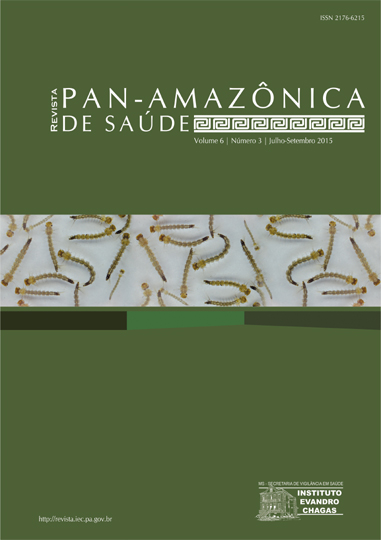
We evaluated rudimentary cesspits as potential breeding sites for the mosquito Aedes aegypti and mosquito production compared to those officially designated common breeding sites (CBS). In November and December of 2009, immature forms of the insect were collected in water samples of cesspits as well as of CBS, the latter being any object that potentially accumulates water such as used tires, flower pots and sites of solid waste disposal. Samplings were performed in urban areas of two municipalities of Rondônia State in the Brazilian Western Amazon. Immature and adult forms of Ae. aegypti were observed in cesspits confirming these as novel breeding sites for the mosquito in that region. The proportion of cesspits found with Ae. aegypti immature forms in the two surveyed localities were as follows: Espigão do Oeste, 50.0% and Jaru, 27.3%. Moreover, the average number of insects did not differ significantly in the sampled cesspits and CBS. These results provides subsidies for change in the policies and strategies of dengue vector control in Brazil, taking into account the limited sanitation infrastructure and the local particularities of the Amazon Region. They also point to the urgency of investments and adequacy of efforts in systems of public sanitation in developing countries, to aid in the control of this important vector of viral diseases.
Downloads
Downloads
Published
How to Cite
Issue
Section


